US Citizenship - Free online Course on US Citizenship
Representation
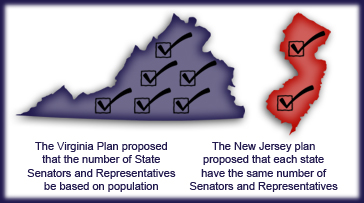
When Edmund Randolph, the governor of Virginia, presented Madison’s Virginia
Plan, the delegates from the small states objected strongly to the scheme of
representation in the plan’s proposed legislative branch. The Virginia Plan,
which called for the creation of a new national government with separate
executive, legislative, and judicial branches, created a bicameral legislature,
or a legislature with two houses — a House of Representatives and a Senate. It
wasn’t the notion of two separate houses, though, that bothered the small state
delegates; it was that the number of a state’s representatives in each house
would be based on its population.
Under the Articles of Confederation, states were the fundamental unit of
political organization and power. As such, they had been viewed as equal to each
other, regardless of their population, and each state was accorded one vote in
the Confederal Congress. Madison’s plan, however, was based on the notion that
the power and authority of the government was derived directly from the people
and, therefore, the degree of authority each state surrendered to the national
government was in direct proportion to its population. Madison and other
supporters of the Virginia Plan — primarily delegates from the larger states —
argued that it was unjust for a small number of people from states such as
Delaware to have the same number of representatives as a much larger number of
people from states like New York. The delegates from the small states, however,
argued that by basing representation in both houses on the population of each
state, the interests of the smaller states would be trampled upon by a
large-states dominated Congress.
In response to the scheme of representation outlined in the Virginia Plan,
the smaller states proposed the New Jersey Plan, which called for the equal
representation of each state in both houses of the new Congress. The large
state delegates were just as opposed to this plan as the small state
delegates had been to the Virginia Plan. For a time, the Convention was at
an impasse on the issue of representation and the Convention was even in
danger of dissolving over the issue. Roger Sherman of Connecticut, however,
is credited with proposing what has come to be called the Great Compromise
of the Convention. Under this plan, the representation of states in the
Senate would be equal — each state would choose two senators, regardless of
its population. In the House of Representatives, however, the number of
representatives elected in each state would depend on population.
To further emphasize the importance of states as distinct political entities
with special status under the new Constitution, the Convention also provided
that senators would be chosen by the legislatures of the several states and not
be elected directly by the people, as House members would be. The agreement
literally saved the Constitutional Convention.